Helping children find words for what they feel
Children who can name an emotion have more ways to handle it than children who cannot. A practical look at building emotional vocabulary without turning it into a lesson.
Updated · Two Homes Together
Most young children have about four words for feelings: happy, sad, mad, and scared. Everything else gets sorted into one of those, and quite a lot of it ends up in “mad”, because mad is the one with the most energy behind it.
The useful work is not teaching a child to feel differently. It is giving them more words, so that the thing they are feeling has somewhere precise to go.
Why the words matter
A child who can say “I feel left out” is describing a situation that an adult can do something about. The same child without that phrase has to show you instead — usually by doing something that gets a reaction. Vocabulary turns a behavior problem into a conversation.
It also gives a child a handle on the feeling itself. Something with a name is smaller than something without one.
How to build it without making it a lesson
- Name your own feelings out loud, in ordinary moments: “I’m frustrated with this door.” Children borrow vocabulary long before they produce it.
- Offer a word rather than demanding one. “That looked disappointing” gives them something to accept or correct; “how do you feel?” can be a wall.
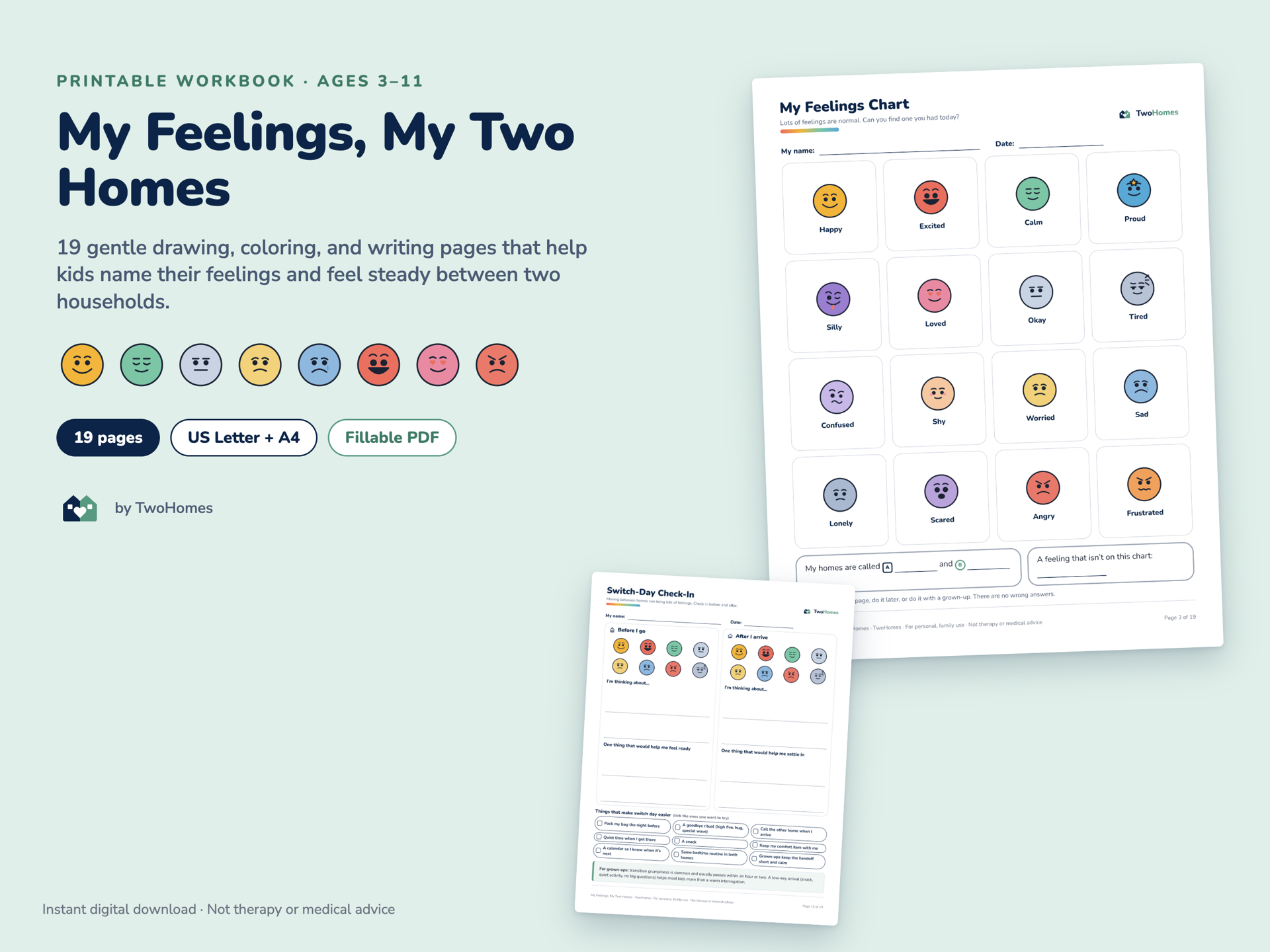
- Use faces and pictures with children who cannot yet read. Pointing is a much lower bar than speaking.
- Notice feelings in stories and on screens. It is far easier to discuss a character’s jealousy than a child’s own.
- Accept more than one answer. Children can feel two contradictory things at once, and often do.
Separate the feeling from what they did
This is the distinction that does most of the work. A child is allowed to feel furious. What we work on is what happens next. Collapsing the two — treating the anger itself as the offense — teaches children to hide feelings rather than handle them, and hidden feelings do not get smaller.
Listen before fixing
Let them decline
A child who does not want to talk about it should be allowed not to, and told so explicitly. A check-in that can be refused is a check-in they will eventually use. One that cannot be refused becomes an interrogation they learn to give flat answers to.
What this is not
Building emotional vocabulary is ordinary parenting, not treatment. It does not diagnose anything and it does not replace a therapist. If a child’s distress is intense, persistent, or getting in the way of sleep, school or friendships, speak to a professional who can actually assess them.
A general guide, not advice about your family