Writing things down: keeping a factual co-parenting record
What a useful co-parenting record contains, what it should leave out, and why writing to a template is easier than writing to a feeling.
Updated · Two Homes Together
Co-parenting generates a steady stream of small agreements: a pickup moved by an hour, a dentist appointment, a decision about a school trip. Individually they are trivial. Collectively they are impossible to hold in your head, and the gap between what two people remember is where most conflict starts.
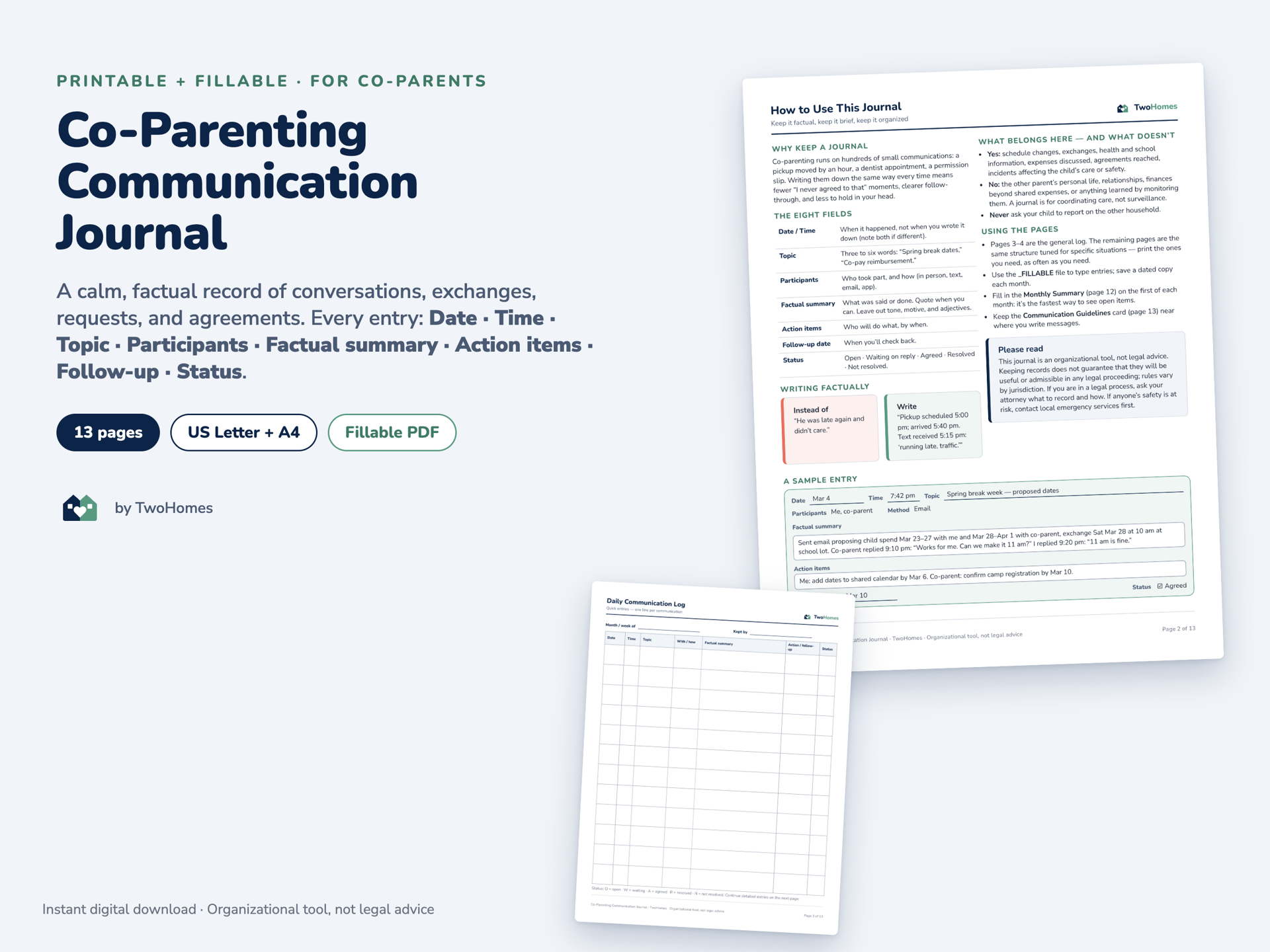
The same fields, every time
The single most useful property of a record is consistency. If every entry captures the same things, you can find anything in seconds and you never have to decide what to write.
- Date and time
- Topic — a few words, not a paragraph
- Who was involved
- A factual summary of what was said or decided
- Any action items, and who owns them
- A follow-up date, if one is needed
- Status — open, done, or waiting
Factual means factual
There is a real difference between “collection was 50 minutes late; no message was sent beforehand” and “he was late again, as usual, because he doesn’t care”. The first is a fact. The second is a conclusion, and conclusions are both arguable and corrosive to re-read.
Write what a neutral observer would have seen. Keep what you were told separate from what you witnessed. If you are recording an inference, label it as one.
A record is not a weapon
The BIFF approach for messages
For the messages themselves, a widely used shorthand is BIFF: brief, informative, friendly, firm. Short enough not to invite a essay in reply, informative enough to be actionable, friendly enough not to escalate, and firm enough to hold the point.
Most of the benefit comes from “brief”. Long messages contain more things to object to.
What to leave out
- Commentary on the other parent’s character or new relationships
- Anything a child told you in confidence that is not a safety concern
- Speculation about motives
- Anything you would not want your child to read at eighteen
An honest limit
A personal record is a coordination tool. It is not evidence in any formal sense, it is not legal advice, and whether anything in it matters in a legal context is a question for a family-law attorney in your jurisdiction.
A general guide, not advice about your family