Making switch day easier for children
Why the day a child moves between homes is often the hardest one of the week, and the small, practical things that reliably take some of the sting out of it.
Updated · Two Homes Together
Parents often notice that the difficult behavior clusters around one day. The child who is fine on Tuesday and impossible on Friday is not being difficult about Friday; they are managing a transition, and transitions are hard work for small nervous systems.
What is actually happening
A switch asks a child to do several things at once: stop what they are doing, leave a place they have settled into, carry their own belongings, anticipate a different set of rules and rhythms, and manage whatever they imagine the parent they are leaving will feel about it. Adults find this tiring. Children have fewer tools for it.
The behavior you see — stalling, clinginess, sudden fury about a sock — is usually the overflow, not the cause.
Things that help, in rough order of impact
Make the timing visible
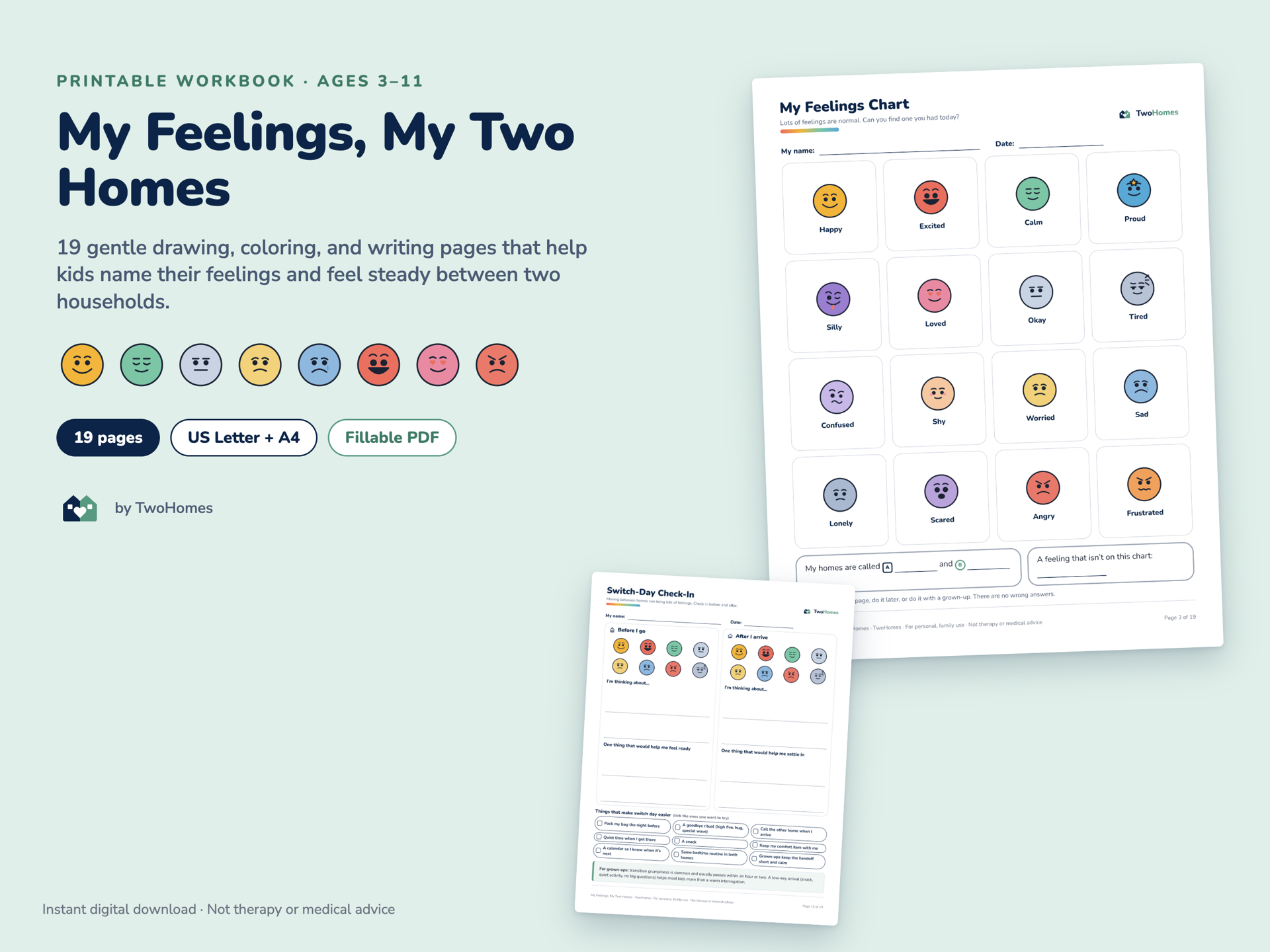
A child who can see that Friday is a switch day, on a calendar they helped color in, is not ambushed by it. Most of the distress of a transition is the surprise of it, and that part is solvable with a piece of paper on a wall.
Let them pack their own bag
Give a child a checklist they can work through themselves — pictures if they cannot read yet — and the switch becomes something they do rather than something done to them. It also means that when something is forgotten, it is a problem to solve rather than a failure to assign.
Keep the handover short and flat
Long goodbyes extend the hardest moment. A brief, warm, confident handover tells a child that this is normal and survivable. If the two adults find each other difficult, a doorstep is not the place to work on that.
Have an arrival routine
The first twenty minutes at the other home matter more than most of the rest of the evening. The same small sequence every time — shoes off, bag in the same place, a snack, ten minutes of nothing in particular — lets a child land before anyone asks them anything.
Do not interview them
“What did you do? Was it fun? Did you miss me?” is a lot for a child who has just walked in, and the last one is a question they cannot answer safely. Wait. Most children tell you things sideways, hours later, while doing something else.
The comfort object is not optional
What not to read into it
A child who cries at a handover is not giving you evidence about the other home, and a child who leaves cheerfully is not rejecting you. Transition distress is about the transition. It usually eases as the arrangement becomes familiar, and it often reappears briefly after holidays or any other break in the pattern.
If distress is severe, persistent, or accompanied by changes in sleep, appetite or school, that is worth raising with a professional who knows your child.
A general guide, not advice about your family