Choosing a custody rotation: 2-2-3, 2-2-5-5, or week on / week off
A plain-language comparison of the most common parenting-time rotations, what each one asks of a family, and the questions worth answering before you pick one.
Updated · Two Homes Together
Most parenting-time arrangements are a variation on a handful of patterns. None of them is correct, none is required, and the right one depends far more on your geography, your work and your children’s ages than on the pattern itself. What follows is what each rotation actually asks of a family.
Before anything else
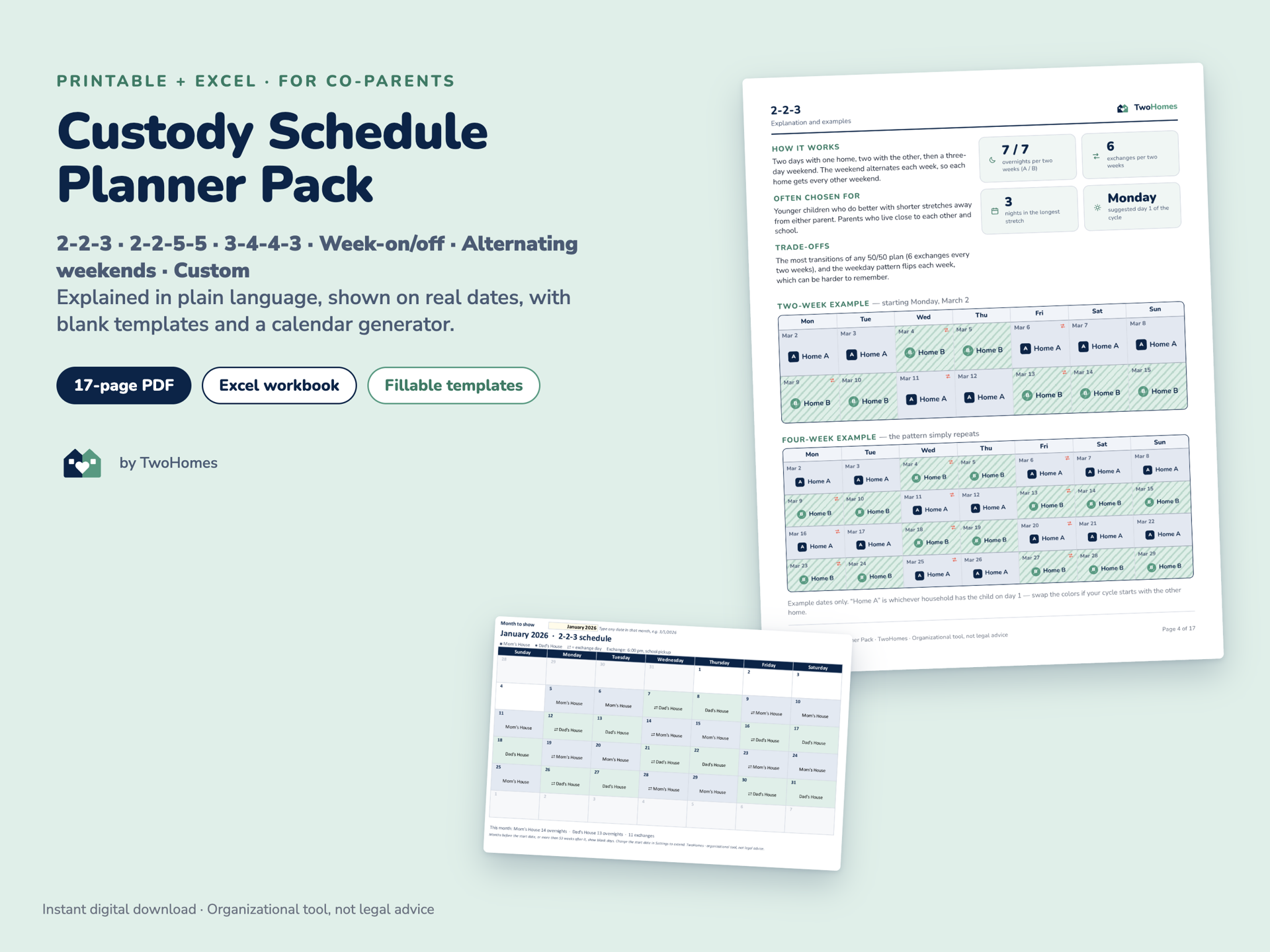
2-2-3
Two nights with one parent, two with the other, then three, and the pattern flips the following week. Over a fortnight each parent gets an equal share, and no child goes more than three nights without seeing either parent.
It is often chosen for younger children, who tend to feel long gaps more acutely. The cost is frequency: this is the rotation with the most exchanges, which means the most handovers, the most packing, and the most opportunities for a small logistical problem to become an argument. It works best when the homes are close together and the parents can be civil at a doorstep.
2-2-5-5
Two nights with one parent, two with the other, then five and five. Each parent always has the same two weekdays, which makes the midweek routine genuinely predictable — the same parent does swimming every Tuesday — while still splitting the fortnight evenly.
Fewer exchanges than 2-2-3, but a child does spend five consecutive nights away from each parent. For school-age children who have adjusted to the arrangement, that is usually manageable; for a three-year-old it may not be.
3-4-4-3
A fortnight split three, four, four, three. The weekday pattern alternates between weeks, so each parent gets a long weekend every other week. It is a reasonable middle ground, but the alternating weekdays make it the hardest of the common rotations to hold in your head — this is one to put on a wall calendar.
Week on / week off
The simplest pattern there is: a full week each, usually exchanged on a Friday or a Sunday. One exchange a week, one bag packed, no mental arithmetic.
The trade-off is the length of the gap. Seven nights is a long time for a young child, and families often soften it with a midweek dinner or a scheduled call. It tends to suit older children, especially teenagers who value not living out of a bag.
Alternating weekends
One parent holds the weekdays and the other has every other weekend, sometimes with a midweek evening. It is not an equal split and it is usually driven by circumstance — distance, shift work, a parent who travels — rather than preference.
If this is your arrangement, the weekends carry a lot of weight. Protecting them from being eaten by admin and catch-up chores matters more than it does in an even split.
Questions worth answering first
- 1How far apart are the two homes, and can both do the school run?
- 2How old are the children, and how do they currently handle a few nights away?
- 3Which parent can realistically be present on which weekdays, given work?
- 4Where and when will exchanges happen, and who transports?
- 5What travels with the child, and what lives permanently at each home?
- 6How will you handle the week one of you is away, or a child is ill?
The last three are, in practice, where most arrangements fail. The rotation is the easy part; the exchange logistics are what get re-argued. Write them down once, somewhere both homes can see them.
Try it on real dates
A pattern that looks sensible described in words can look very different mapped onto an actual month with a bank holiday and a school trip in it. Before you commit, lay the rotation over the next two months and check it against what is already in the diary.
A general guide, not advice about your family